

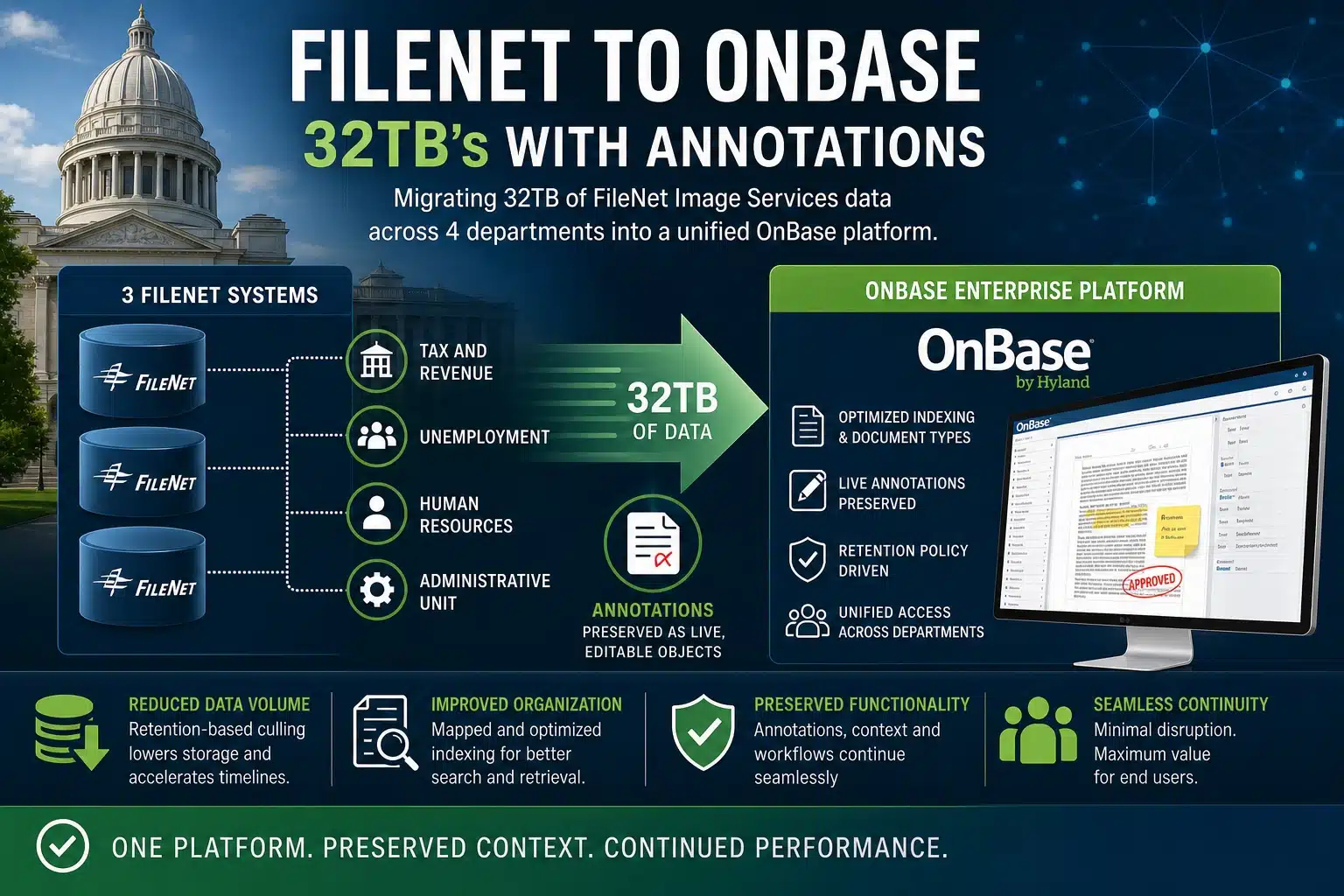
Case Study: Statewide FileNet to OnBase Migration Across Multiple Departments
When state governments modernize enterprise content management platforms, the challenge isn’t just moving data - it’s preserving context, maintaining compliance, and ensuring continuity across departments with very different operational needs.
That was the situation facing a statewide initiative to consolidate multiple legacy FileNet Image Services systems into a single Hyland OnBase enterprise platform.
Through a long-standing reseller partner, 4matix was engaged to migrate three separate FileNet systems supporting four departments -Tax and Revenue, Unemployment, Human Resources, and an additional administrative unit- into a unified OnBase on-premise environment.
The Challenge: Fragmented Systems and Critical Data Dependencies
Each department relied heavily on its FileNet system, not just for document storage but for day-to-day operations. Over time, these systems had grown independently, creating inconsistencies in indexing structures, document classes, and annotation usage.
In total, the environment contained approximately 32 terabytes of document data, along with extensive annotation records - many of which were essential to business processes, especially within the Unemployment department.
This wasn’t a simple lift-and-shift.
The state needed:
- Accurate migration of high-volume document repositories
- Preservation of annotations as live, usable data - not static images
- Alignment of FileNet indexing structures with OnBase document types and keywords
- Reduction of unnecessary data based on retention policies
- Minimal disruption to departmental workflows
The Approach: Structured, Intelligent Migration
4matix approached the project with a focus on precision and efficiency, working through the OnBase reseller while maintaining close alignment with state stakeholders.
1. Data Analysis and Retention-Based Culling
Before any migration began, 4matix analyzed the FileNet repositories against state-provided retention rules. This step eliminated redundant, obsolete, or non-compliant data before it ever reached the new system.
This had immediate benefits:
- Reduced total migration volume
- Lowered infrastructure and storage costs in OnBase
- Accelerated overall project timelines
Instead of migrating everything, the state migrated only what mattered.
2. Indexing Structure Mapping
FileNet systems often evolve organically, resulting in complex and inconsistent metadata structures.
4matix extracted and documented:
- Document classes
- Index fields
- Data relationships
This information was then used to design equivalent - or improved - structures and schemas within OnBase. All of these tested and verified before production ever started.
3. Annotation Discovery and Transformation
One of the most critical - and often overlooked - components of FileNet migrations is annotation data.
4matix conducted a full inventory of annotations, including:
- Types (highlights, notes, stamps, redactions)
- Volumes and distribution across documents
- Functional usage within each department
Rather than flattening these into static images, 4matix converted annotations into fully functional, live OnBase annotations.
This ensured that users could continue interacting with documents exactly as they had before - editing, updating, and leveraging annotations as part of their workflows.
For departments like Unemployment, where annotations are integral to case processing, this capability was essential.
4. Scalable, Multi-Department Execution
With three separate FileNet systems and four departments involved, coordination was key.
4matix executed the migration in a structured, phased approach, ensuring:
- Data integrity across systems
- Consistent transformation logic
- Alignment with the broader statewide OnBase rollout
The Outcome: Unified Platform, Preserved Functionality
The migration successfully transitioned approximately 32TB of FileNet Image Services data into the state’s OnBase enterprise platform.
Key outcomes included:
- Consolidation of multiple legacy systems into a single ECM platform
- Preservation of annotation data as live, editable objects
- Improved document organization through optimized indexing structures
- Reduced storage footprint through retention-based data culling
- Seamless continuity for end users across departments
Just as importantly, the state avoided one of the most common pitfalls of ECM migrations: losing the operational value embedded in legacy systems.
Why This Matters
Many organizations underestimate the complexity of migrating from FileNet Image Services specifically - and ECM systems generally - especially when annotations are a business critical part of the repository.
This project demonstrates a more effective approach:
- Treat data migration as data transformation, not just movement
- Prioritize usability and continuity for end users
- Use retention rules to drive efficiency and cost savings
- Preserve—not compromise—critical business context
For government agencies and enterprises alike, the lesson is clear: the success of a migration isn’t measured by how much data you move, but by how well that data continues to work afterward.
4matix Contact:
David Blackburn
VP Sales
dblackburn@4matix.com
For more information about our FileNet Conversion offerings please visit - FileNet Conversions and Migrations - and for information about Conversions into OnBase - please visit here. Our ECM data migration questionnaire can found here.
All trademarks, trade names, and logos mentioned or used in this context are the property of their respective owners.